
Wednesday, February 18, 2015
Monday, December 8, 2014
eight by the eight on the eighth
They weren't the only artists to depict scenes of winter, but The Eight
a/k/a The Ashcan School did seem to have a particularly fine
ability to capture snowscapes and cities in the early 20th century. As
evidenced by these eight works, although I included George Bellows (an
Eight associate and student of Henri but not an official member) because I
wasn't able to find a snowy painting by Arthur B. Davies. Davies
was reportedly one of the least ashcanny of The Eight, however, and
seemed to
favor more lyrical inspiration vs urban realism.


Pictured: Snow in New York -- Robert Henri (1912); Backyards, Greenwich Village -- John Sloan (1914); Cross Streets of New York -- Everett Shinn (1899); Old Grand Central -- Ernest Lawson; Sledding, Central Park -- William Glackens (1912); Winter Night, New York -- George Luks (1930); Snow in April -- Maurice Prendergast (1907); Blue Snow, The Battery -- George Bellows (1910)
Pictured: Snow in New York -- Robert Henri (1912); Backyards, Greenwich Village -- John Sloan (1914); Cross Streets of New York -- Everett Shinn (1899); Old Grand Central -- Ernest Lawson; Sledding, Central Park -- William Glackens (1912); Winter Night, New York -- George Luks (1930); Snow in April -- Maurice Prendergast (1907); Blue Snow, The Battery -- George Bellows (1910)

Saturday, November 29, 2014

Sunday, November 16, 2014
born today

Pictured: West Side Ramp -- circa 1935 (Smithsonian American Art Museum)
Wednesday, June 4, 2014
so said cezanne

Painting from nature is not copying the object, it is realizing sensations.
Pictured: Le Lac d'Annecy -- Paul Cézanne, 1896 (Courtauld Gallery, London)
Saturday, May 17, 2014
a bit of ruskin

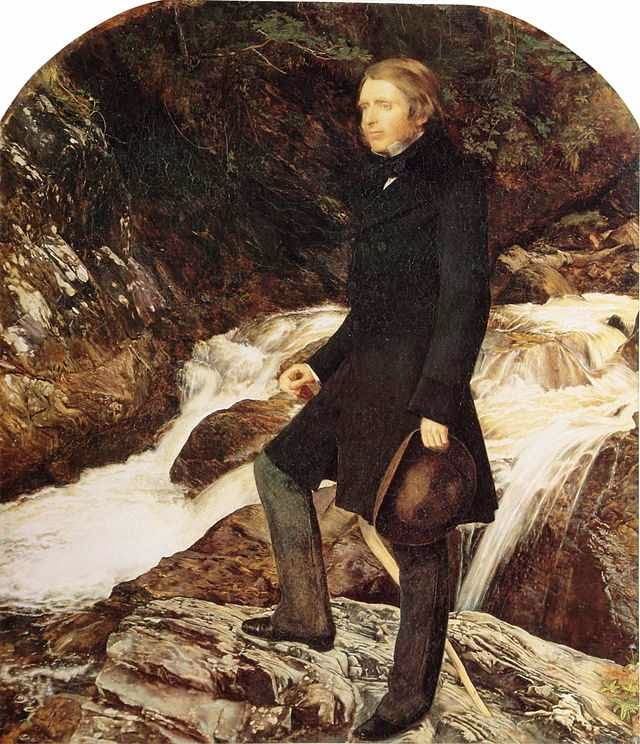


Sunshine is delicious, rain is refreshing, wind braces us up, snow is
exhilarating; there is really no such thing as bad weather, only
different kinds of good weather.
Ruskin's life -- particularly the eventual love triangle of his ambiguous marriage -- continues to inspire other artistic efforts, including two films made almost 100 years apart (1912's The Love of John Ruskin and 2013's Effie). Love him or hate him, he's kept some people thinking since he first formed a cohesive opinion, which probably involved critiquing the arrangement of wooden alphabet blocks in his nursery.
What we think, or what we know, or what we believe is, in the end, of little consequence. The only consequence is what we do. -- John Ruskin
(Pictured: Little Ruskin by John Nortcote, 1822; Ruskin by John Everett Millais, circa 1853; Self-Portrait from 1875; Ruskin by W.G. Collingwood, 1897)
Wednesday, April 23, 2014
will he was
Today brings the 450th birthday of William Shakespeare, or rather the day that Shakespeare's birthday is celebrated. Actual birth records weren't always clear back then, but since Shakespeare was baptized around this time and died on April 23rd, the same date is used to mark his birth. Nonetheless, Shakespeare was of course a poet, iconic playwright, perhaps a Taurus, and the man responsible for keeping generations of actors busy portraying characters in his major works, as well as portraying Shakespeare himself. (Most of the actors have been British but then again, Shakespeare was a fellow Englishman.)
Shakespeare's plays have also inspired artists to paint scenes from his plays, several of which are featured below. And personally my favorite Shakespearean passage is from Macbeth and found to be nightly true: "Sleep that knits up the ravelled sleave of care. The death of each day's life, sore labour's bath. Balm of hurt minds, great nature's second course, Chief nourisher in life's feast."


Pictured after Shakespeare: Portia by John Everett Millais, 1886; The First Madness of Ophelia by D.G. Rossetti, 1864; Othello and Desdemona by Antonio Muñoz Degraín, 1880; and Miranda - The Tempest by John William Waterhouse, 1916
Shakespeare's plays have also inspired artists to paint scenes from his plays, several of which are featured below. And personally my favorite Shakespearean passage is from Macbeth and found to be nightly true: "Sleep that knits up the ravelled sleave of care. The death of each day's life, sore labour's bath. Balm of hurt minds, great nature's second course, Chief nourisher in life's feast."
Pictured after Shakespeare: Portia by John Everett Millais, 1886; The First Madness of Ophelia by D.G. Rossetti, 1864; Othello and Desdemona by Antonio Muñoz Degraín, 1880; and Miranda - The Tempest by John William Waterhouse, 1916
Subscribe to:
Posts (Atom)