Showing posts with label suite101. Show all posts

Wednesday, June 8, 2011

art and the house of mirth


More Suite101 blog reposting....

I’ve always loved the chapter from Edith Wharton’s 1905 novel The House of Mirth, where ladies of New York society take part in an evening of "living pictures" or tableaux vivants. For the entertainment of their guests, and for the presumed showcasing of themselves, the costumed women pose within sets designed to resemble classic paintings. These illusions depend "not only on the happy disposal of lights and the delusive-interposition of layers of gauze, but on a corresponding adjustment of the mental vision. To unfurnished minds they remain, in spite of every enhancement of art, only a superior kind of wax-works; but to the responsive fancy they may give magic glimpses of the boundary world between fact and imagination."

By this point in the novel, we’ve become familiar with the female characters and to link some of them with art is aesthetically fun — and a nice fictional device by Edith Wharton. We know about the translucent-skinned "frailer Dutch type" of old New York money, perfect for bringing a van Dyck to life. We also know about the resourceful and resilient Carry Fisher, who despite being a divorcee when divorce was still questioned has managed to keep herself within society circles. With her earthy dark looks she becomes one of Goya’s women for the night, from the "exaggerated glow of her eyes" to the "provocation of her frankly-painted smile."

Then there’s Lily Bart, The House of Mirth’s heroine — beautiful, capricious, determined to find a rich husband yet not quite calculating and manipulative enough to pull that feat off. Lily chooses Sir Joshua Reynolds’ Mrs. Lloyd as her tableau, knowing that its simpler lines and similarity to her own loveliness will be a show-stopper. Which it is, and Lily is a true vision — with some of the men of course wondering privately about whether she’s got any underwear on beneath those "pale draperies" that outline "dryad-like curves."

The tableaux evening is a high point in Lily’s otherwise troubled quest to become one of New York's truly powerful society women — and to no doubt eventually have her own beautiful, slightly haughty portrait painted by John Singer Sargent.

Pictured: La Maja Vestida (Francisco de Goya, ca. 1800) & Mrs. Richard Bennett Lloyd (Sir Joshua Reynolds, ca. 1775) -- click on each painting to get a closer look

Saturday, May 21, 2011

that lunatic impressionist gang


(More Suite101 blog reposts....)

The French Impressionists initially had to organize their own exhibits because the official Paris Salon wouldn’t consistently accept their works. When those indie shows were reviewed by certain art critics of the day, the feedback could be downright nasty. While some admired their new perspective, others sniped how:

“Here five or six lunatics deranged by ambition -- one of them a woman -- have put together an exhibition…They take canvas, paint and brushes, splash on a few daubs of color here and there at random, then sign the result. The inmates of the Ville-Evrard Asylum behave in much the same way…Try telling M Pissarro that trees are not purple, or the sky the colour of butter…Try to explain to M Renoir that a woman’s torso is not a rotting mass of flesh, with violet-toned green spots all over it...There is also, as in all famous gangs, a woman. Her name is Berthe Morisot, and she is a curiosity. She manages to convey a certain degree of feminine grace in spite of her outbursts of delirium.”

That was critic Albert Wolff behind that 1876 rampage, and as a result of it, Berthe Morisot‘s husband Eugene (also painter Edouard Manet‘s brother) challenged Wolff to a duel, though I don’t think any swords were ever drawn or pistols fired. Clearly, Mr. Wolff would be horrified by the crowds who still flock to museums to view French Impressionist paintings, and by all the Monet tote bags and Degas and Renoir calendars for sale in the gift shops.

Wolff’s tirade is included in Sue Roe’s very interesting and smoothly flowing The Private Lives of The Impressionists (HarperCollins). The book gives factual and biographical information, but it also heightens the personalities and friendships of the artists so that it reads more like a novel. Definitely worth checking out.

(Pictured: Buttery sky by Camille Pissarro -- Apple Pickers at Eragny, 1888 -- Dallas Museum of Art)

Tuesday, May 3, 2011

pigeons, pollock and other talented creatures


Again, our Suite101 Feature Writer blogs are due to be shut down soon so I'm reposting some of the entries here....

There are new and unusual schools of art -- and then there are the spoofs that follow. Click here to see if you can recognize the works of either some spirited and colorful chimps or bonafide human painters. Back in 1964, the canvases of an emerging French talent named Pierre Brassau came upon the art scene in Sweden, with one critic praising Brassau's style as having the “delicacy of a ballet dancer.” Pierre eventually turned out to be a chimp named Peter from the zoo, who probably didn’t even get any of the money earned from the sale of his stuff before the big revelation. This same website also gives you the chance to guess whether you’re looking at a Pollock or some abstractly messy pigeon crap -- or if you want to get literary, whether text is oddly computer-generated German translation or actual William Faulkner prose.

(Pictured: Study of Birds and Monkey, J. van Kessel, circa 1660)

Wednesday, April 20, 2011

whistler's special sauce


Our Suite101 Feature Writer blogs are being removed from the site as of May 1, so I'll repost some of the entries that got the most traffic here....

For many artists, the creation of a unique persona and lifestyle is often as interesting as creating the art itself. Never one to quietly accept what he’d been handed, the great James McNeill Whistler rejected the notion of being born in sensible Lowell, Massachusetts and instead invented alternate backdrops for his coming into being. ("I shall be born when and where I want, and I do not choose to be born in Lowell….") While Whistler's actual and not fabricated childhood was in Europe, he found himself putting in an incongruous stint at West Point Academy following the death of his father. He then headed to Paris to pursue the whole bohemian artist experience before eventually making London his home base.

Robert M. Crunden’s book American Salons features fascinating characters like Whistler who reinvented themselves between the 19th and 20th centuries, and in the process changed the course of art, fiction, poetry, music and life in general. Here's an excerpt regarding Whistler’s painting method:

Nature gave him its inspiration, while the Japanese gave him intuitions about what to do with it…He had a large palette, a board two feet by three with a butterfly inlaid at one corner, on which he laid out his colors, the pure at the top. He then mixed large quantities of the prevailing color in the intended picture, producing results so juicy that he called it “sauce”…[h]e had to lay his canvas on the ground because the sauce would run if the canvas were in any way tilted -- sometimes it did anyway, and he often accepted the accidental results….

"If the man who paints only the tree, or flower, or other surface he sees before him were an artist, the king of artists would be the photographer. It is for the artist to do something beyond this." (James McNeill Whistler, 1834-1903)

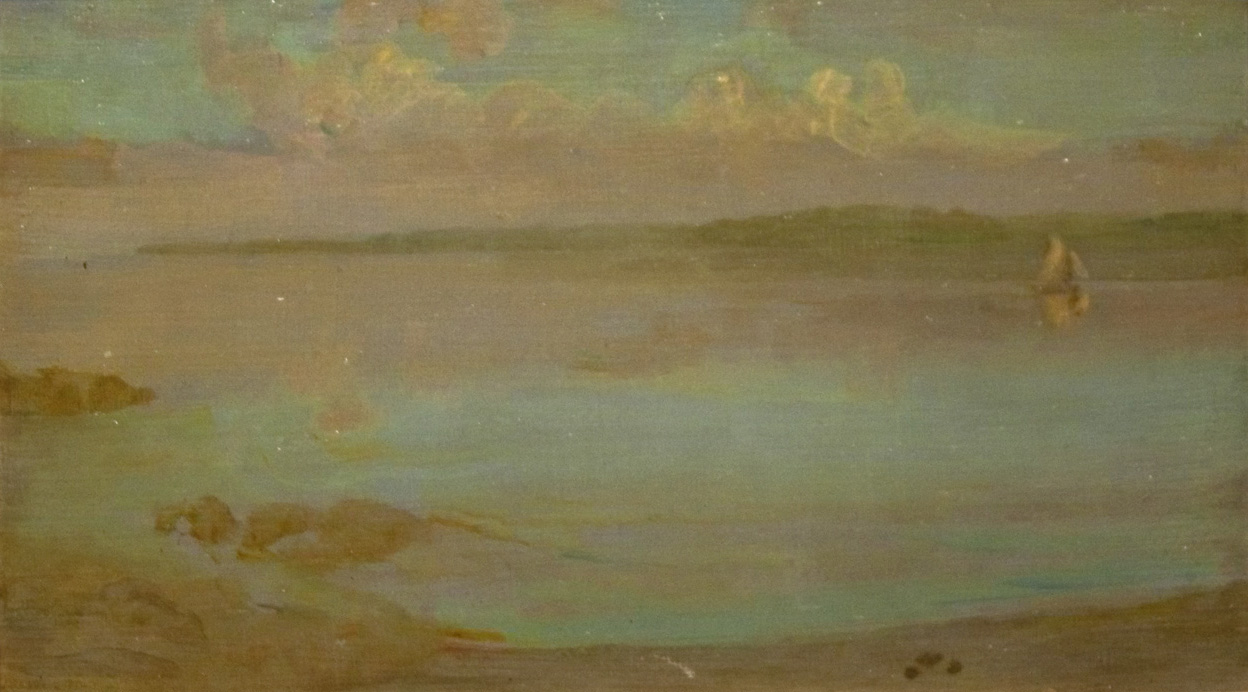
Pictured: Whistler's 1900 Gray and Gold -- The Golden Bay (Hunter Museum of American Art)

Saturday, November 6, 2010

rivera at the rock

I just finished writing a Suite101 article about Diego Rivera's Rockefeller Center mural in the old RCA now GE Building a/k/a 30 Rock, and how he somehow thought that he could showcase a major tribute to Lenin in 1930s Bolshevik-hating Depression-era midtown Manhattan. Nelson A. Rockefeller on behalf of the Rockefeller Dynasty said no way, and though Rivera was able to keep his commission, the work was ordered demolished.

Rivera wanted to take photos of the mural for future reference but was barred from going near the site again, although one of his assistants--the intriguingly talented Lucienne Bloch--snuck in and managed to snap some pictures herself. Rivera later replicated the project at Mexico City's Palacio de las Bellas Artes and José Maria Sert took over in New York to produce a non-controversial backdrop for the Rockefellers and their Center.

This incident was part of the storylines of Tim Robbins' The Cradle Will Rock, with Ruben Blades as Rivera, and in Salma Hayek's Frida, which cast Alfred Molina as the Mexican mural master. Rivera has been played by a variety of actors, but my favorite painted portrait of him was done by Modigliani when Rivera was younger and looks sort of roundly kind-hearted and mischievous at the same time.

(Pictured: Portrait of Diego Rivera -- Amedeo Modigliani, 1914)

Thursday, August 12, 2010

summer morning


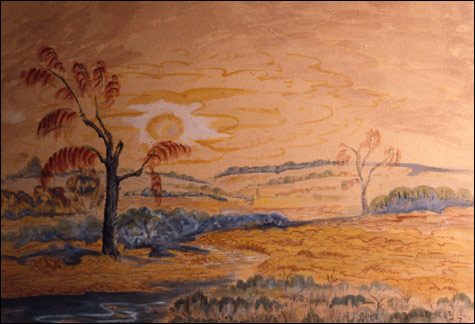
Charles Burchfield (1893 – 1967) was an American artist who preferred to work in watercolors and at varying points in his career created uniquely intense nature studies. 1917 was one of his most prolific years with an output that included the pictured Summer Morning, from the Midwest Museum of American Art. Charles also designed wallpaper in Buffalo as a day job for a while, and he later expressed his firm opinion that Pablo Picasso was the "evil genius of modern art" who "wittingly or unwittingly, brought about a decadence that is really terrible to behold."


Thursday, May 20, 2010

who was that masked man


It sounds like a French heist film-to-be starring maybe Jean Reno and Mathieu Kassovitz, and it ended with the Paris Museum of Modern Art losing five major paintings to a hooded, masked, after-hours bandit. I wrote a
Suite101 blog entry about the art theft earlier today, and pictured here is the 1911 Picasso work that was stolen -- Le Pigeon aux Petits Pois. The paintings were said to be slit from their frames for faster access, which also means permanent damage to the canvas edges. Still, to make off with a Picasso, Matisse, Modigliani, Leger and Braque in one fell swoop is formidable for an art thief -- but truly just awful for the museum.

Tuesday, May 11, 2010

day of the Dalí


May 11th was once the birthday of a very famous Catalonian, the moustachioed attention-loving eccentric genius known as Salvador Dalí. I wrote an article for Suite101 on Dalí's famed 1931 melting time dreamscape The Persistence of Memory and it has always gotten the most page views of all my articles every single day for almost two years. Nobody ever beats him -- not even Picasso. Because that's just the enduring power of Dalí's supposedly headache and gooey cheese-induced vision, expressed upon a canvas that's much smaller than most people expect it to be. This Dalí alarm clock can help you start your day off in a pleasantly bizarre manner, and since Dalí himself seemed to love the combination of art and enterprise, I'm sure he'd approve.

The only difference between me and the Surrealists is that I am a Surrealist. -- Salvador Dali

Wednesday, March 10, 2010

abstractly postal

I just wrote a Suite101 blog bit about the U.S. Post Office's latest visual arts series being issued tomorrow, with ten paintings by Abstract Expressionist (or Abstractionists, as one of my professors used to call them) notables like Mark Rothko, Jackson Pollock, Robert Motherwell and Arshile Gorky. Chicago native Joan Mitchell is the lone female in the group and the Suite101 post is mainly about her. In terms of Gorky, he was born Vostanik Manoog Adoyan on April 15, 1904 in Armenia; he survived his homeland's horrific genocide, immigrated to America and reinvented himself as Arshile Gorky. His work was fascinating and haunted yet often vibrant with color; his later life was troubled with personal problems and devastating physical ailments and he hung himself in 1948 surely just to escape it all. His featured painting among the Abstract Expressionist stamp series is the intriguingly-titled 1944 The Liver is the Cock's Comb (Albright-Knox Art Gallery), pictured here.

Monday, March 1, 2010

the small-towner, the farmer and the ozark hillbilly


I tend to like the American Regionalists, because of their historical context and the epic kind of declaration that their artworks send forth. I've written Suite101 articles on Grant Wood and Thomas Hart Benton and John Steuart Curry's John Brown mural, but I found it interesting to read Robert Hughes' section on Regionalism in his juicy 600+ page art history American Visions book. The myth of Regionalism tends to be that it sprang up naturally from the earth like Benton's wheaty inspiration pictured here, reasserting America's presence in art and rejecting European "isms". Apparently it was a more calculated egg hatched within the mind of Mr. Maynard Walker; Walker was from Kansas originally, but by the 1930s he had established himself in New York as an art dealer. Walker figured that making art more accessible and "homegrown" would tap a whole new audience and could exploit social anxieties during the Great Depression.

Regionalism promoted America's past and future energy and gave art back to the people. Or so the general buzz went, particularly Time Magazine's December 1934 feature on Regionalism with Benton on the cover. But Benton himself would confess that the real deal was that: "A play was written and a stage erected for us. Grant Wood became the typical Iowa small-towner, John Curry the typical Kansas farmer, and I just an Ozark hillbilly. We accepted our roles." And they kept those roles throughout the rest of their careers, even when Regionalism lost its initial momentum. Over the years, however, the collective dynamic of Benton, Curry and Wood resurged and became important in a different sense -- still mythic and exaggerated, but perhaps in a uniquely mythic and exaggerated American way.

(Image: Wheat -- Thomas Hart Benton, Smithsonian American Art Museum)

Wednesday, February 3, 2010

newly distinguished


Abstract painter William Conger became part of the Chicago Union League's roster of Distinguished Artists last month, joining such other notables as Ed Paschke and Ruth Duckworth. I had the chance to interview Bill Conger last spring for Suite101.com -- a really enjoyable experience because he's a great conversationalist and can talk about anything. Click here to read the interview and here for Bill's official website.

(Pictured: Chinatown -- Wm. Conger, 2007)

Thursday, January 14, 2010

violet femme

Long-ago birthday girl Berthe Morisot was born January 14, 1841, and during her artistic career she would become associated with the French Impressionists. She was good friends with Edouard Manet and there may have even been more to their relationship; Manet was married, however, and Berthe herself later wed Manet’s brother Eugene. Edouard was a guiding and occasionally overbearing influence, but this black-hatted portrait he did of Berthe in 1872 (Berthe Morisot with a Bouquet of Violets) is really lovely and shows his fondness for her and the unique character of her face.

Sunday, January 3, 2010

august born in january

August Macke is definitely on my list of favorite artists, born January 3, 1877 in Meschede, Germany. A key member of the German Expressionist group Der Blaue Reiter, Macke was an amazing colorist whose death at the age of twenty-seven in World War I was such a huge loss. Macke was drafted and it's doubtful that he wanted to go off to fight, and he perhaps even had a premonition of impending tragedy which he conveyed in Farewell, one of his last works. This painting is called Turkish Cafe II and was done on a trip Macke made to Tunisia, just before reluctantly joining the German armed forces. His good friend and fellow Blaue Reiter member Franz Marc was also killed in World War I in 1916, about two years after August's death.

Thursday, October 1, 2009

oak park moments


This quote (sort of) etched in stone by Italian poet and writer Cesare Pavese was glimpsed at Oak Park's Eastgate Cafe, which even seems like a place where you might have once found Cesare Pavese drinking coffee and contemplating life. His first name is off by one small letter but otherwise those are definitely his words. Oak Park is well-known for former citizens Frank Lloyd Wright and Ernest Hemingway, but another Oak Parker worth noting is Philander Barclay. Philander rode his bicycle around the town back in the early 20th century and left behind a cultural and historical legacy of close to a thousand photographs of Oak Park as it was then. Click here  to read more about Philander, and here  to see some of his photographs.

Thursday, September 10, 2009

repin's russia


Looking at the works of artist Ilya Repin (1844-1930) is a great way to learn about Russian history and culture, ranging from Repin's depictions of the Volga Boatmen to scenes from Eugene Onegin to portraits of major literary, artistic and political figures of his time. Repin also had a true gift for capturing the essence of his portrait subject, such as his wonderful impressions of author Leo Tolstoy and his appealingly lost-in-thought painting of composer Nikolai Rimsky-Korsakov.

Even if you don't initially recognize the person in one of Repin's portraits, you're likely to be intrigued enough by the visual image to want to know more. This painting of Vsevolod Garshin seems really striking, and further research revealed that Garshin was a writer whose father and brother had committed suicide, and that Garshin eventually committed suicide himself in 1888 at the age 33. He showed considerable literary promise in his short life, and he also posed for Repin's Czar Ivan the Terrible With the Body of His Son (State Tretyakov Gallery, Moscow) as Ivan's son. In that particular painting, we learn how Czar Ivan unintentionally murdered his own son Ivan in 1581 during an argument by beating him with his staff. Ivan's son was reportedly upset because Czar Ivan had argued earlier with the son's pregnant wife, and in defending her the final fight between father and son came to pass. They were an intense pair of Ivans, so it seems like some kind of tragedy was inevitable. It's eerie and sad to see Garshin in that pose as the dead son, however; Garshin's portrait by the way is now at the Metropolitan Museum of Art in New York.